


A day, or a week, in Lourmarin
Lourmarin takes half an hour to walk across, and you will stay all day. A Renaissance castle, Albert Camus' grave, three bell towers, a Friday market that fills every street, and the only road that crosses the Luberon from one side to the other. Here is what to see, when to come, and how to plan it.
- Home
- The Luberon
- A day, or a week, in Lourmarin
Why Lourmarin, and not another village
Geography gave Lourmarin its position. The village sits precisely where the mountain range breaks open: the Combe de Lourmarin, carved out by the Aigues Brun stream, is the only natural gap between the Petit Luberon and the Grand Luberon. Everything crossing the massif from north to south passes through here. That explains the castle, the size of the village, and the activity you still find in it today.
Lourmarin is one of five Luberon villages classified among the "Plus Beaux Villages de France", alongside Ansouis, Gordes, Ménerbes and Roussillon. It is small. You can walk across it in half an hour if you walk in a straight line. Nobody walks in a straight line in Lourmarin.
Worth knowing before you set off:
- The market is held on Friday mornings, all year round, from 8am to 1pm.
- The castle opens daily, with hours that change with the season.
- Albert Camus' grave is in the village cemetery, freely accessible.
- Parking is free on the edges of the village, but hard-won on Fridays.
- The Régalon gorges have been closed since autumn 2025.
The village and its lanes
Walking without a plan
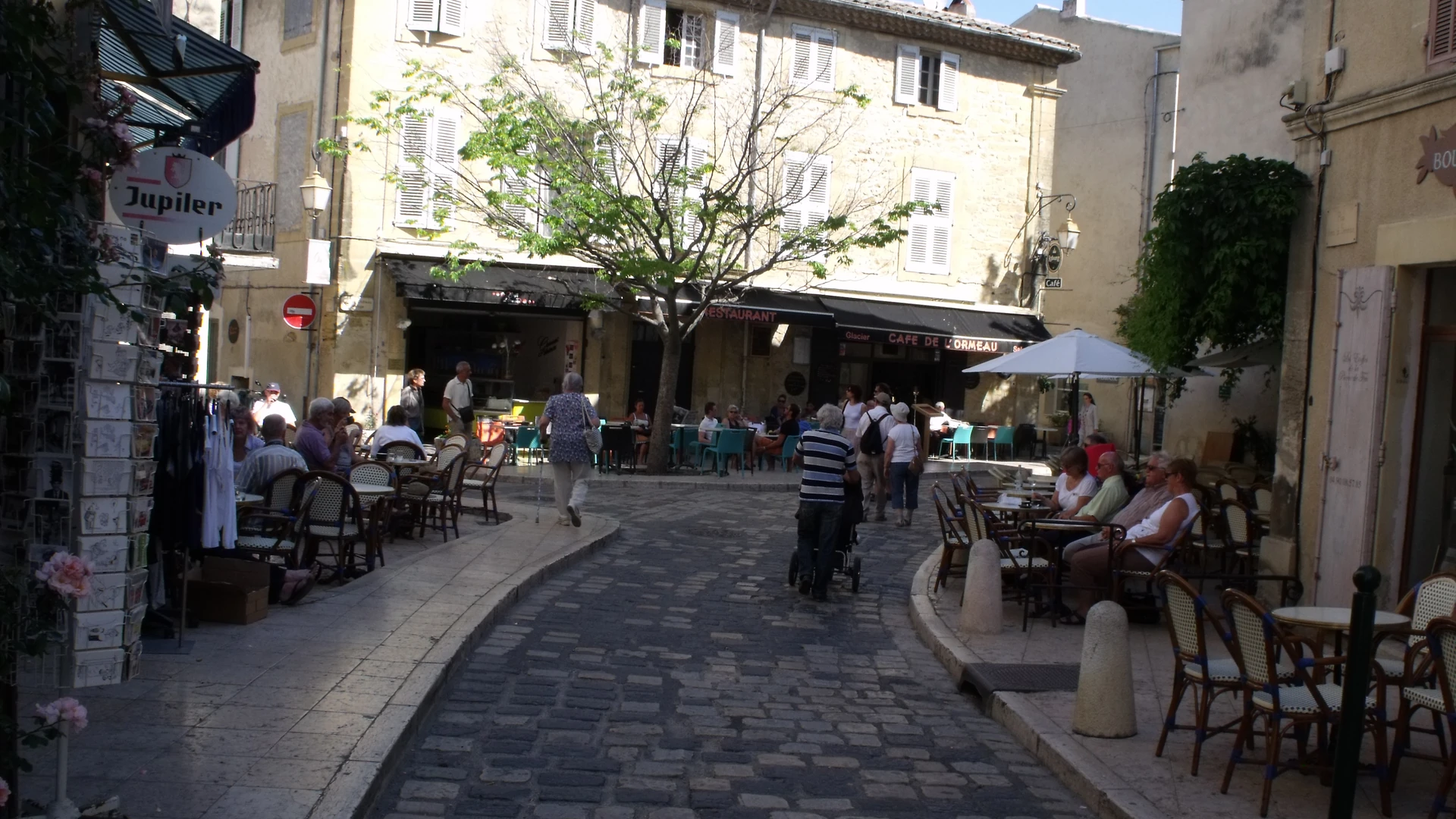
The old centre is made for walking, and that is the only sensible way to see it. The streets climb gently, narrow, turn back on themselves. Façades run from ochre to beige to pale grey, and no two sets of shutters are quite the same colour. There are fountains at almost every junction, old studded doors, pots of basil on the thresholds. You do not need a map: the village is small enough to get lost in harmlessly, which is rather the point.
Look up as you go. Dated lintels, external staircases and covered passageways tell the story of a village rebuilt several times over. Early morning or late afternoon is best, when the light rakes across the walls.
Three bell towers
You recognise Lourmarin from a distance by its three silhouettes. The belfry, also called the Castellas, houses the public clock and stands on the foundations of a medieval fortification. The church of Saint-André-et-Saint-Trophime blends Romanesque and Gothic. The Protestant temple, finally, sums up the village's history on its own: begun in 1806 to plans by the architect Michel-Robert Penchaud, inaugurated in 1817, and listed as a historic monument in 1991.
That temple is not a piece of scenery. In the fifteenth century the local lord, Foulques d'Agoult, brought in Waldensian families to repopulate an emptied village. That community left a lasting mark on the Luberon before being persecuted in the following century, and Lourmarin remained a Protestant village. Three bell towers for a village of this size is an anomaly with a reason behind it.
Château de Lourmarin
It stands above the village to the west, at the end of Avenue Laurent-Vibert. It is described as the first Renaissance castle in Provence, and the building bears that out: an older wing built at the end of the fifteenth century by Foulques d'Agoult, and a Renaissance wing raised from 1526 onwards. The château is protected as a historic monument: park and terraces since 1946, the building since 1948.
Abandoned after the Revolution, the castle was bought and restored in 1920 by Robert Laurent-Vibert, who bequeathed it to an academy in Aix on one condition: that it become a residence for artists. It still is. Painters, sculptors and musicians stay here, and the summer season brings concerts and exhibitions. The Renaissance wing is furnished and holds collections spanning the fifteenth to the nineteenth century.
Practicalities: the castle opens daily, closing on 25 December and 1 January, with an annual closure of a few days in mid-January. Hours follow the season — 10.30am to 6.45pm from May to September, 10.30am to 5.45pm in April and October, and split hours of 10.30am to 12.45pm then 2.30pm to 5.15pm from November to March. Last admission is 45 minutes before closing. Full price is €8, concessions €6.50, €3.50 for ages 6 to 12, free below that. These details change from year to year, so check before you travel.
Allow a good hour, longer if you climb to the terrace for the view over the plain and the gap of the combe. We have devoted a full guide to the castle and Camus' grave if you want more of the history.
Albert Camus' grave
In 1958, with his Nobel Prize money, Camus bought a former silkworm farm in Lourmarin. He wrote here, lived here on and off, and was buried here after his death in a car accident in January 1960. The grave lies in the village cemetery on Avenue Henri-Bosco, a few minutes' walk from the centre.
Do not look for a monument. It is a plain stone, overgrown with rosemary and irises, shaded by an oleander. Francine Camus lies beside him. A little further along the same cemetery, a simple slab bears the name of Henri Bosco, another Luberon writer, who died in 1976. The two men lived a few streets apart and had little to do with each other.
Two useful points. This is a working village cemetery, still in use, so keep it quiet. And Camus' house, on the street that now carries his name, cannot be visited — it is a private home. You can walk past it, and that is all.
The village tourist office runs an occasional guided walk following the writer's traces. It is seasonal and needs booking in advance.
Friday morning market
This is the event that changes the shape of the village. Lourmarin's market runs every Friday, all year round, from 8am to 1pm, through the centre. In high season it ranks among the largest in the Vaucluse, spilling off the squares onto the boulevards and side streets. Food first — growers, cheese, olives, spices, fish — but also textiles, basketwork, soaps and crafts.
Three pieces of local advice. Arrive before 9am: you will be able to move, to talk to the producers, and to park. After 10.30am in July the village is saturated and the heat has settled in. Second, park on the edge straight away and finish on foot; trying to reach the centre by car on a Friday morning costs more time than walking. Third, bring a bag — stallholders do not always provide one.
There is a second, quieter event: an evening producers' market on Tuesdays from 5pm to 8pm, mid-April to late October. Smaller, more local, far calmer. Both markets, the stall locations and the addresses worth knowing are covered in our guide to the Lourmarin market.
Terraces, shops and pauses
Lourmarin lives off its shops as much as its heritage. You will find a bookshop, galleries, ceramic studios, wine cellars pouring Luberon vintages, delicatessens and a bakery whose queue is a reliable indicator. The terraces on the squares fill from midday, and most restaurants in the centre are fully booked on Friday and Saturday evenings in summer, so reserve.
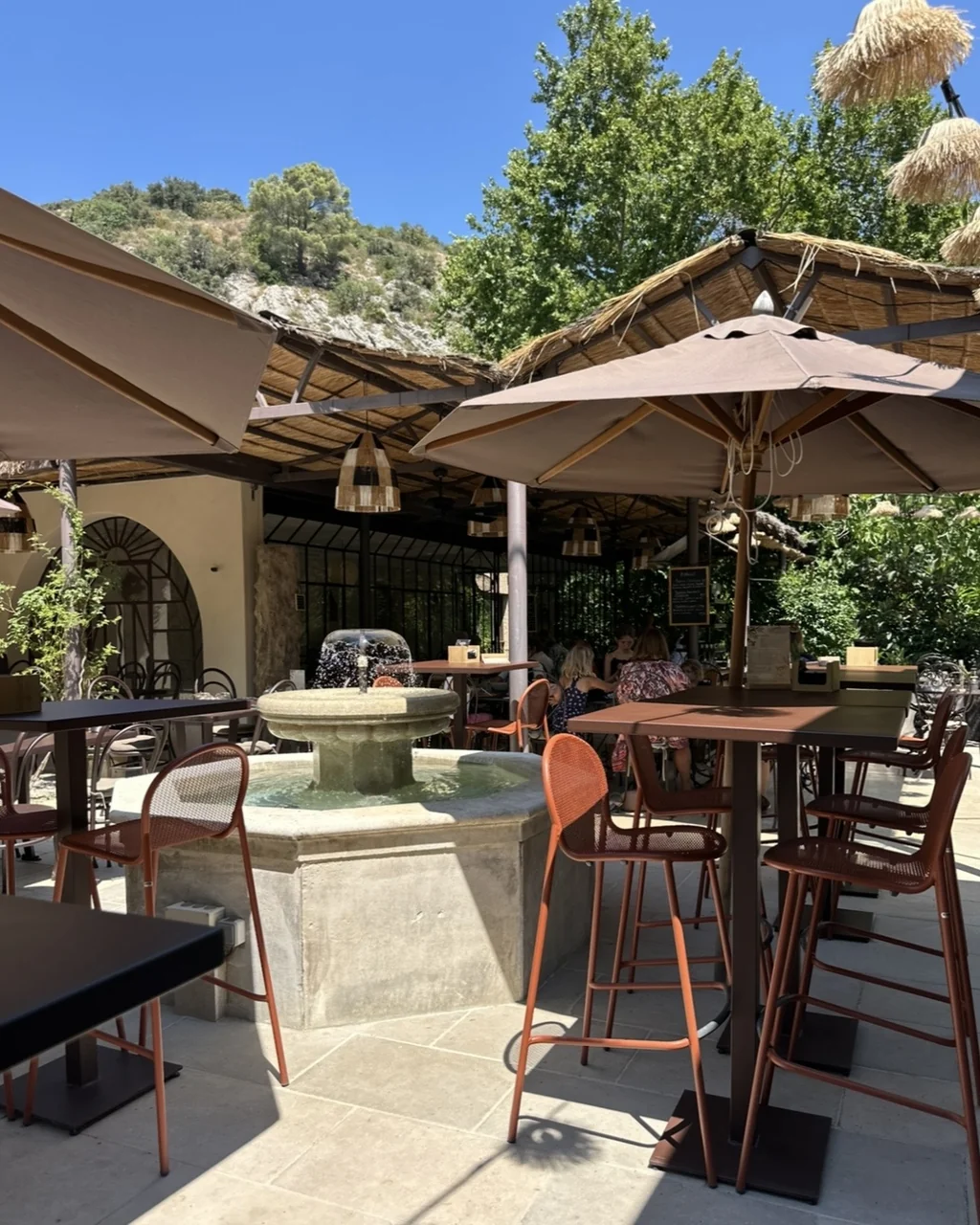
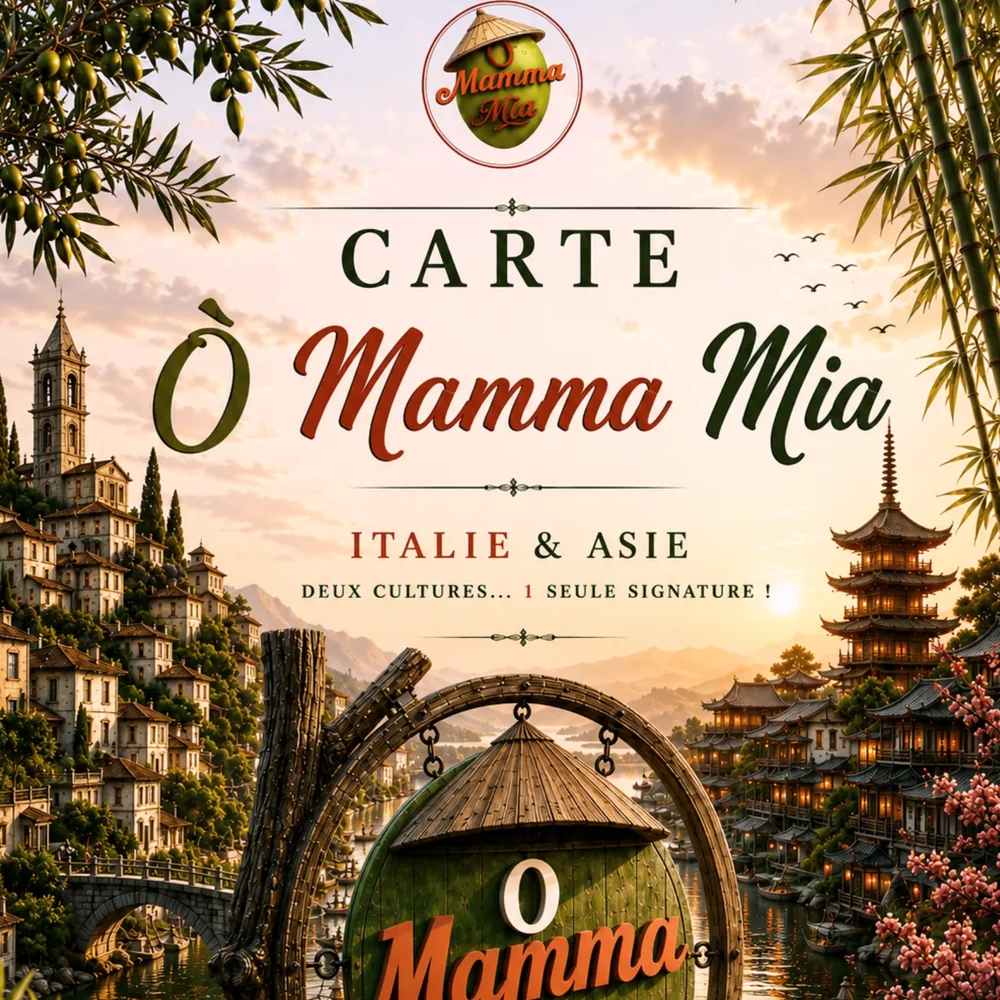
Just outside the village, on the road to Apt, our restaurant serves lunch and dinner seven days a week, under the trees of the estate — Italian and Thai cooking, sharing boards, a cocktail bar. It is also the straightforward answer on days when the centre is overwhelmed: parking is not a question here.
Walking and cycling around the village
The Combe de Lourmarin
The D943 climbs towards Bonnieux and Apt through the combe, between limestone cliffs that close in above the road. It is the only north-south crossing of the massif, and the drive is worth taking for its own sake, by car or by bike. Footpaths leave the valley floor and follow the Aigues Brun towards Buoux, in a coolness that contrasts sharply with the scrubland above. The Fort de Buoux, a fortified spur above the valley, is open for much of the year, with one closing day a week and closures in rough weather — check before setting off, as the final approach is on foot over uneven ground.
The Régalon gorges
This is the walk everyone recommends, and the one you must check first. The Régalon gorges, in the commune of Cheval-Blanc, have been closed since autumn 2025 following rockfalls caused by heavy rain. Reopening depends on a geological survey, and no date has been announced. The car park is still there; entry to the gorges remains prohibited. Consult the commune's website before planning the outing.
Forest access in summer
From 15 June to 15 September, access to the Vaucluse forest massifs is regulated by prefectural order because of fire risk. A map is published each day for the following day, with four levels ranging from open access to full closure. Check it the evening before: a walk cancelled at home beats a closed trailhead.
By bike
Lourmarin is a stage on the "Autour du Luberon" cycle route, a signed loop of roughly 240 kilometres with 2,620 metres of climbing, split into six stages. You can take just one piece of it: the day out towards Cucuron and Vaugines on the southern slope's back roads is gentle and fast-rolling. We rent electric bikes on site, €25 for a half-day and €39 for a full day, by reservation; the routes we recommend are set out in our guide to the Luberon by e-bike.
Neighbouring villages
Lourmarin makes a good base: most of the southern Luberon villages are less than half an hour away by road.
- Cucuron — its Bassin de l'Étang, lined with plane trees planted in the nineteenth century, once the reservoir feeding a flour mill. Shaded terraces, best at the end of the afternoon.
- Vaugines — quieter, with its fountain and a Romanesque church standing alone in the fields.
- Ansouis — a hilltop village, also among the Plus Beaux Villages de France, crowned by its castle.
- Cadenet — busier and more commercial, down by the Durance.
- Bonnieux and Ménerbes — on the far side of the combe, on the northern slope, with the views that come with it.
- Gordes and Roussillon — further out and busier; give them a full day.
Our selection of the most beautiful Luberon villages sets out the routes and the time to allow for each.
One day in Lourmarin
Morning. Arrive early, park on the edge and walk up before the terraces fill. An hour wandering the lanes, the fountains, the three bell towers. Then the cemetery and Camus' grave on Avenue Henri-Bosco — it is short, it is quiet, and it is better in the morning.
Midday. The castle at opening time or shortly after, to avoid mid-afternoon in summer. Allow an hour. Lunch afterwards, booking ahead if there are more than four of you.
Afternoon. The hottest hours are not for walking. Two options: a drive through the combe towards Buoux and Bonnieux in the shade of the cliffs, or a pause by the water. We have a natural pool fed by the river, under the trees of the estate, described on this page.
Early evening. Come back into the village around 6.30pm. The light shifts, the shops reopen, the squares become liveable again. It is the best hour for photographs and for a drink.
Two or three days: what else
Day two — the northern slope. Cross the combe in the morning. Bonnieux, then Ménerbes, and if time allows Roussillon and its ochre cliffs late in the day. Set aside the whole day: the roads are beautiful and slow, which is the point.
Day three — the south, taken slowly. Cucuron and its basin, Vaugines, Ansouis. This is the ideal e-bike circuit from Lourmarin: little climbing, villages close together, a terrace every eight kilometres. If you would rather walk, pick a trail on the southern slope, start early, and check the forest access map between June and September.
If you are here on a Friday, keep the morning free for the market. That alone is reason enough to plan a Thursday-to-Saturday stay.
Staying overnight changes the trip: you see the village before and after the day visitors. We have ten rooms on an estate beside the Aigues Brun a few minutes from the centre — the rooms are all different. To compare areas and options, read where to stay in Lourmarin.
When to come
Spring. The best season, without argument. April and May bring mild days, orchards in blossom, a village that is lively without being clogged. Evenings stay cool, so bring a jacket.
Summer. July and August are hot and full. The village works early in the morning and after 6pm. Book everything: table, room, activities. The massifs are regulated, and sometimes closed, for fire risk.
Autumn. September may be the best compromise: the water is still pleasant, the light is long, the terraces are free. October brings colour to the vines and a village that noticeably quietens.
Winter. The Luberon with nobody in it. The Friday market holds firm, the castle opens on reduced hours, and the walks through the combe are clear. Just check what is open: several businesses close for a few weeks. Our hotel and restaurant are closed on 24 and 25 December, then from 1 January to 14 February; we reopen on the evening of 14 February.
Getting here and parking
By car
The simplest option. From the A7 motorway, exit at Sénas and take the D973 to Lourmarin via Lauris. Allow around twenty-five minutes from Cavaillon and about fifty from Avignon. Coming from the north of the massif, the D943 drops down through the Combe de Lourmarin — much the finest approach.
By train, then car
The useful stations are Avignon TGV and Aix-en-Provence TGV. Neither is within walking distance; hire a car on arrival or arrange a transfer.
By coach
The regional Zou! network serves Lourmarin on local lines linking Cadenet, Cucuron and Aix-en-Provence among others. Frequencies are limited and timetables shift with the school calendar, so check the network before relying on it.
Parking
Lourmarin has several free car parks around the edge of the centre, which is rare in the Luberon. In practice it all comes down to timing: outside Fridays and outside July and August you will find a space easily. On Friday mornings and summer weekends, aim for before 9am or after 5pm. The streets of the centre are narrow and partly pedestrianised — do not try to drive into them.
We have free parking on the estate, 1.5 km from the village: a good twenty minutes on foot. For any question about access or planning, our reception is staffed around the clock — details are on the contact page, and the hotel page describes the estate in more detail.