

The castle and the writer
Provence's first Renaissance château and Albert Camus's grave sit at opposite ends of the same small village. Here is what you will see, what to know before you go, and how to visit the cemetery without disturbing anyone.
- Home
- The Luberon
- The castle and the writer
One village, two visits
Lourmarin fits into a handful of streets. At one end, on the edge of the plain, stands the château. At the other lies the village cemetery, where Albert Camus is buried. A few minutes' walk separates them, and in between sits a village that sheltered three generations of writers.
This guide prepares both visits: the history of the château and what you actually see inside, how Camus came to the Luberon, where his grave is and how to behave once you find it. One thing straight away — the writer's house cannot be visited.
If you arrive by car, this order works best:
- The château, on the edge of the village, plain side.
- Rue Albert-Camus and the old village, on foot.
- The village cemetery, avenue Henri-Bosco.
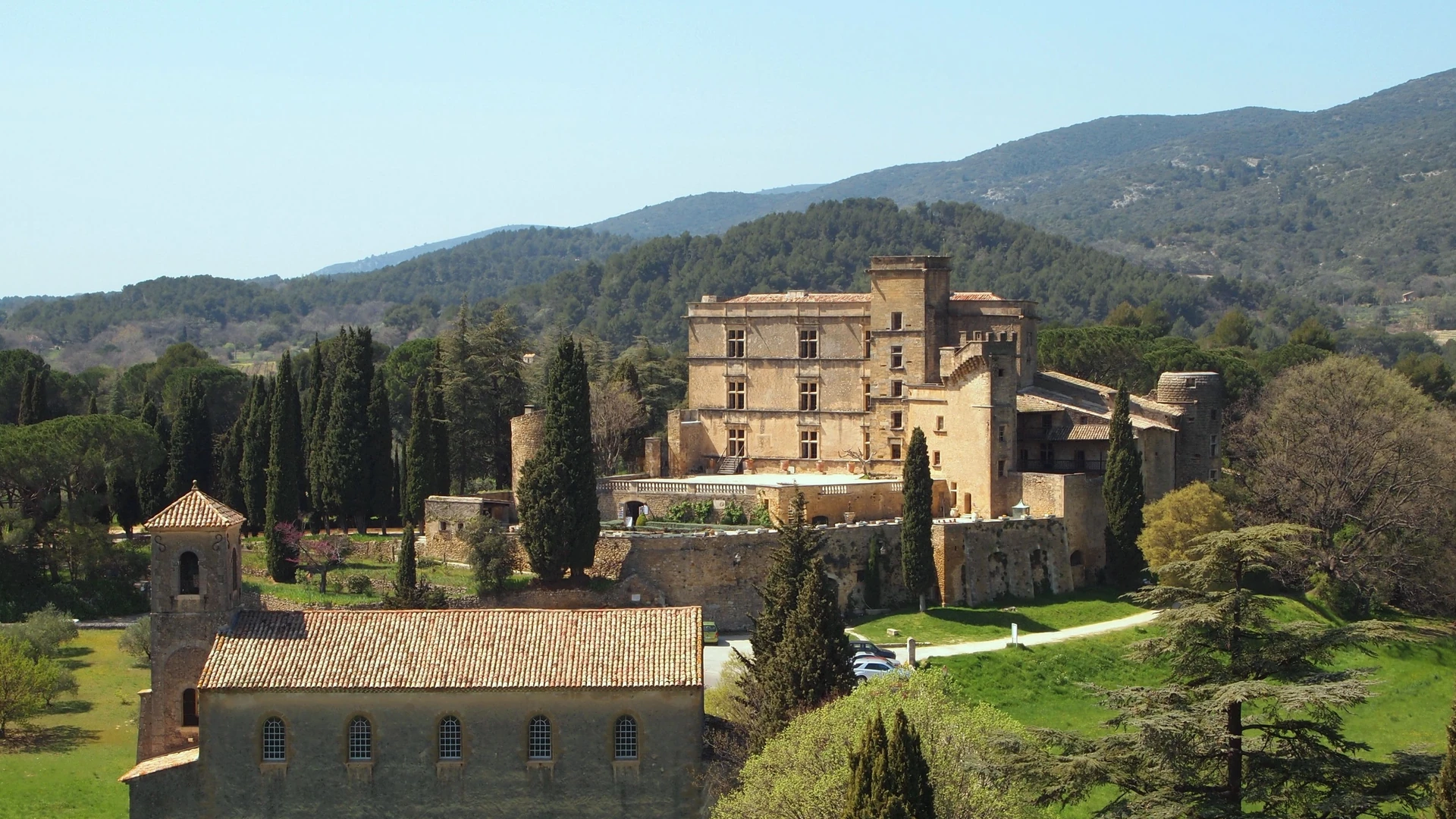
Lourmarin, the first Renaissance château in Provence
The claim appears everywhere, and it holds: the Renaissance wing at Lourmarin was the first of its kind built in Provence. The building reads in two distinct chapters, which is why it repays a slow look from the outside before you even buy a ticket.
The old château and the new one
The oldest part dates from the late 15th century. Foulques d'Agoult had it built on the remains of a 12th-century fortress. The architecture is still medieval: compact, defensive, sparing with its windows.
From 1526, Louis d'Agoult-Montauban and his wife added the Renaissance wing, remarkably consistent in style for the region. Tradition holds that François I stopped here in 1537 on his way back from Italy, and that work continued afterwards under Blanche de Lévis-Ventadour. A large square tower joins the two buildings, so that a few paces take you from the Middle Ages to Italy.
What you see inside
- The great spiral staircase, winding around a central column. It is the most talked-about part of the visit and the hardest to photograph.
- The Italian-style loggia, an open gallery grafted onto the façade — the most frankly Renaissance gesture in the place.
- The fireplaces, one of them carried by caryatids with Amerindian faces. An oddity, at a time when the Americas had only just entered the European imagination.
- Furnished rooms holding collections from the 15th to the 19th century: furniture, objects, musical instruments, a library.
- The terraces, with their view over the plain and the massif.
Allow about an hour to go round without rushing. A treasure-hunt game is usually offered to families, which helps with children.
Before you set off
Opening hours change with the season and admission is charged. The château also hosts concerts and exhibitions, which can alter access on certain days. Check the official château website before you leave — it is the only reliably current source.
A word on parking: in high season, finding a space in Lourmarin takes patience. If you are staying nearby, walking or cycling in solves the problem.
Robert Laurent-Vibert, the man who saved the château
By 1920 the château was little more than a shell. Emptied after the Revolution, it served as rough shelter through the 19th century. It went to auction, and there was serious talk of pulling it down for its stone.
Robert Laurent-Vibert, an industrialist from Lyon and a keen collector, bought it. He had it restored between 1921 and 1923 with the architect Henri Pacon, then moved in his furniture, his objects, his musical instruments and his library. His intention was already settled: the château would become a house for artists.
He died in a car accident in April 1925, the restoration barely finished. His will left the estate to the Académie d'Aix, with instructions to create a foundation. The statutes were approved in 1927 and the Fondation de Lourmarin Laurent-Vibert was recognised as serving the public interest.
An artists' residency since 1929
Since 1929, without a break, the foundation has welcomed young artists and researchers every year. They are housed free of charge, in the château or in a neighbouring house, and receive an allowance to live on. Musicians, visual artists, engravers, sculptors, writers: close to six hundred residents since it began. Hence the nickname the place has never shaken off — the Villa Medici of Provence.
The pianist Jean-Yves Thibaudet stayed here in 1980, the harpsichordist Christophe Rousset in 1983. The foundation puts on some thirty concerts a year, often carried by these young musicians; in summer, several are given on the terraces. This is not a sleeping monument. Work goes on inside it all year.
One name on that long list leads straight into the second half of this guide. Jean Grenier, a resident in 1930-1931, had been the philosophy teacher of a schoolboy in Algiers named Albert Camus.
Albert Camus in Lourmarin
How he ended up here
Camus first heard of Lourmarin from Jean Grenier, who remained his teacher and then his friend. René Char, whom he visited at L'Isle-sur-la-Sorgue, pushed him in the same direction. And there was the landscape itself: the dryness, the low light, the bare hills. Something Algerian, for a man who would never go home again.
In 1958, with the money from the Nobel Prize awarded the previous year, he bought a former silkworm farm in the old village, on what was then grand'rue de l'Église. The street now carries his name.
A private house, not a museum
The house is not open to visitors. It stayed in the family and remains a private, lived-in home. You may well walk past without recognising it, which is exactly as it should be. Camus valued his quiet: local memory has it that he went by the name "M. Terrasse" to be left alone, and that he turned up at the village café like anyone else.
It was here, in the autumn of 1959, that he worked on the manuscript of The First Man, the autobiographical novel he left unfinished and which appeared long after his death.
4 January 1960
He was supposed to take the train back to Paris. Instead he got into the car of his publisher and friend Michel Gallimard, with Janine Gallimard. The car left the road. Camus was killed instantly. He was buried at Lourmarin a few days later, in the village where he had come looking for silence.
Albert Camus's grave, in the village cemetery
The cemetery stands on avenue Henri-Bosco, at the edge of the village. It is an ordinary working municipal cemetery, freely open. No ticket, no shop, no loud signposting.
How to find it
Do not look for a monument — you would walk straight past. Camus's grave is a low stone laid flat in the ground, half swallowed by rosemary and irises, shaded by an oleander. It carries a name and two dates, 1913-1960. Nothing else.
Beside it lies Francine Camus, née Faure (1914-1979), his wife, a pianist. The two plots match: the same restraint, the same planting, the same refusal of display.
The cemetery is small and a few minutes are enough to walk the whole of it. On the way you will pass other names: Henri Bosco, the former minister Raoul Dautry, the poet Christian Gabrielle Guez Ricord.
The respect the place is owed
This is the part of the guide that matters. The cemetery is not a tourist site: people from Lourmarin come here for their own dead, sometimes at the very moment you are hunting for the grave. A few obvious rules, easily forgotten in a group:
- Keep your voice down. A village cemetery carries sound from one end to the other.
- Do not stand on neighbouring slabs to frame a photograph.
- Take nothing away: not a sprig of rosemary, not a pebble.
- If you leave something, leave little, and nothing plastic.
- Give the visit a miss on a day when a funeral is taking place.
The plainness of that stone is not accidental. In 2009 there was a proposal to move Camus to the Panthéon; his son opposed it and he stayed here. That fits what Lourmarin had given him in the first place: nothing more than somewhere to work and be quiet.
Henri Bosco, the other writer of Lourmarin
There is a reason the cemetery sits on avenue Henri-Bosco. Born in Avignon in 1888 and died in Nice in 1976, Bosco spent much of his life between a small farmhouse lost in the hills and the château, whose foundation he helped administer from 1941. The two halves of this guide meet in him.
He had asked in writing that his ashes be brought back to Lourmarin should he die elsewhere. The wish was honoured. His grave is a plain slab topped by a stele bearing Greek characters.
His books grew out of these hills: Le Mas Théotime, awarded the Prix Renaudot in 1945, L'Enfant et la Rivière, Malicroix. They are still widely read in Provence, less so elsewhere. If you are spending a few days in the southern Luberon, they match the landscape in front of you.
Making a day of it
The château takes an hour, the cemetery ten minutes. That leaves plenty of day. A few sensible extensions:
- The village itself, its lanes and workshops: our guide to things to do in Lourmarin.
- The Friday morning market, one of the largest in the Luberon: day, hours and practical advice.
- The neighbouring villages — Cucuron, Vaugines, Ansouis, Bonnieux: our selection.
- The southern Luberon by back roads: the Luberon by e-bike.
- Staying the night rather than driving off at dusk: where to stay in Lourmarin.
Our own house, O Mamma Mia, stands on route d'Apt, a few minutes from the village, on an estate crossed by the Aigues Brun: a natural pool, a terrace under century-old trees, free parking and a reception desk open around the clock. Free parking counts for more than it sounds on a Friday market day. We also hire out electric bikes, €25 for a half day and €39 for a full day, on request — the château, the cemetery and the nearby villages all work well that way.
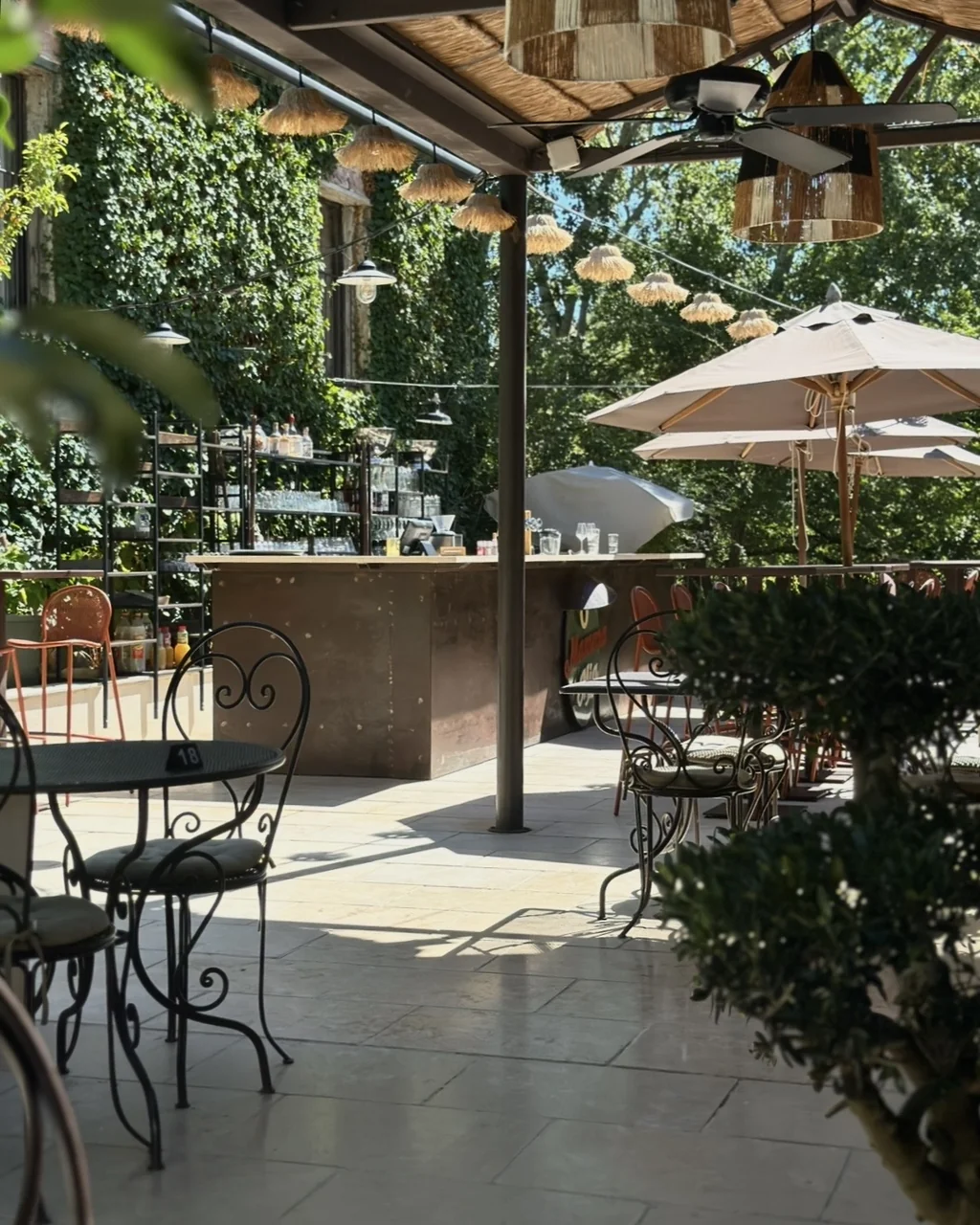
The restaurant serves lunch and dinner, seven days a week: Italian and Thai cooking, and a cocktail bar. Lunch 12:00 to 14:00, dinner 19:00 to 23:00. After a morning spent climbing and descending a spiral staircase, the shaded terrace makes its case, and the natural pool makes it faster.