


Riding out from the door
Luberon villages sit high and Lourmarin sits low, so every good day here starts with a climb. Four rides from the village, the Calavon greenway, and what you really need to know before heading out in summer.
- Home
- The Luberon
- Riding out from the door
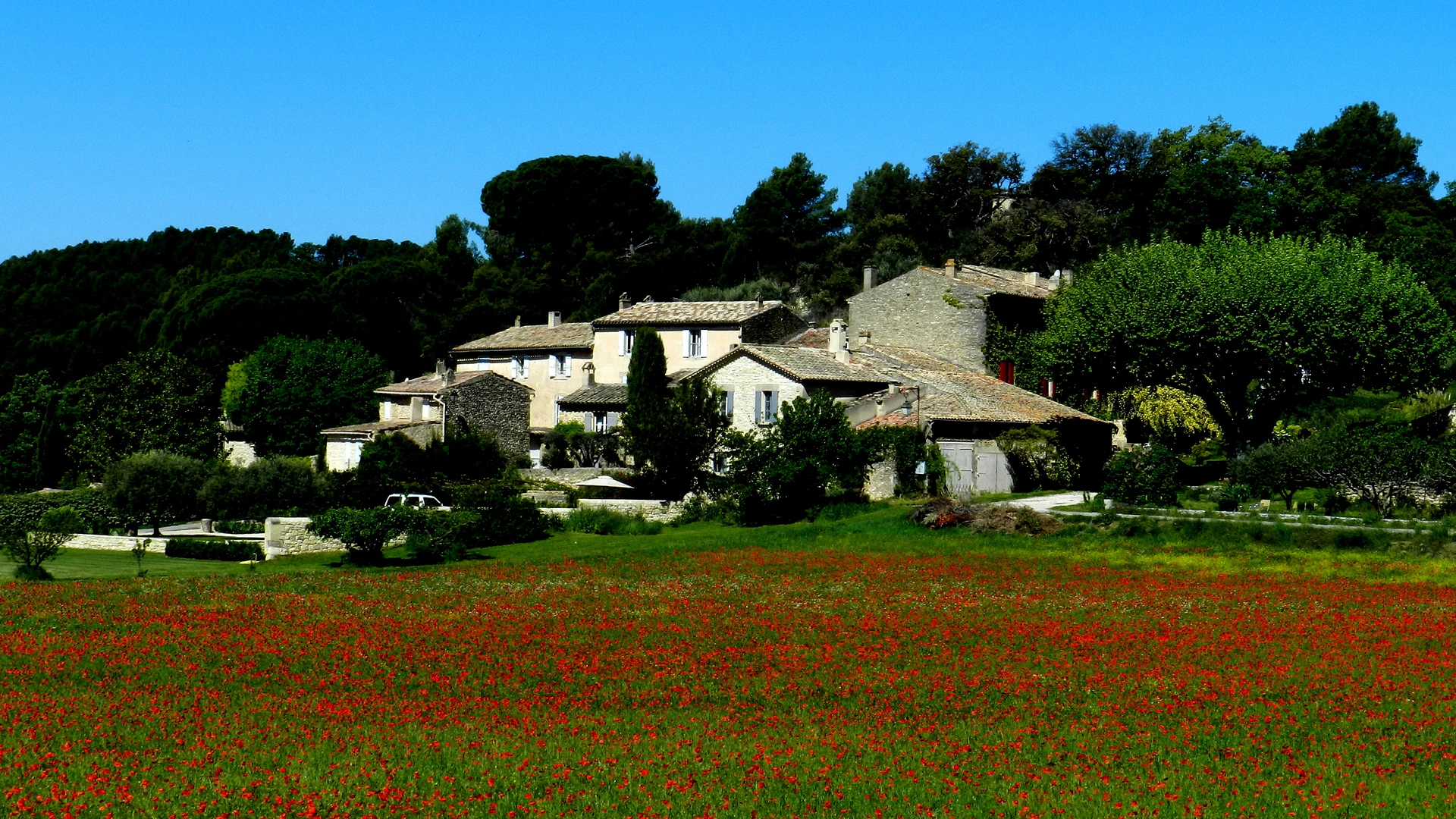
The Luberon is admired from below and visited from above. The villages that made its reputation were all built on a ridge or a rocky spur, the better to see trouble coming. From Lourmarin, which sits at the mouth of the gorge, almost every good day therefore begins with a climb.
That is what an electric bike changes. Not the landscape, which needs no help, but the arithmetic you do over a map: will I actually make it back? With a motor, the answer is yes.
This guide is written from the foot of the massif. Real routes, timings rather than distances — here, a kilometre of plain and a kilometre of gorge have nothing in common — and a few precautions most visitors only learn once they are already out.
Why an e-bike changes the Luberon
The massif reads as two blocks. To the west, the Petit Luberon, a wooded plateau whose cedar forest sits at around 700 metres. To the east, the Grand Luberon, crowned by the Mourre Nègre at 1,125 metres. Between them runs the Combe de Lourmarin, the only road crossing the massif from north to south in this part of the park.
Nothing alpine, then. But short, steep gradients, repeated at almost every village. The waymarked loop around the massif totals roughly 2,620 metres of climbing, which gives a fair idea of what this terrain asks of you, however gentle it looks from a car. Add the mistral and July heat, and you understand why so many visitors leave the bikes alone.
Assistance removes the arithmetic. It does not make the ride passive, but it turns a climb you were dreading into steady effort. A couple who would have settled for the village market can, on an e-bike, have lunch in Cucuron, take in Ansouis and be home before aperitif hour.
What assistance does not do
- The motor cuts out at 25 km/h. Above that you are pedalling a heavy bike under your own steam, so do not expect to fly across the plain.
- Range is not a fixed number. It depends on the assistance level, the load, the wind and above all the climbing. Ride in eco mode on the flat, save the power for the hills, and plan to get back with about a third of the battery left.
- An e-bike is heavy. Descending, especially in the gorge, brake earlier than you would at home and treat the bends with respect: you arrive faster than you think.
Four rides from Lourmarin
Timings are generous and include stops and a coffee. All four start and finish in the village.
1. The southern villages: Vaugines, Cucuron, Ansouis
Easy to moderate · 3 to 4 hours
Leave Lourmarin heading east on the small roads that skirt the foot of the Grand Luberon, between vines, olive trees and dry-stone walls. Vaugines comes quickly. Stop for its Romanesque church, standing apart from the houses: its façade and the fountain beside it served as a set for Claude Berri's Jean de Florette and Manon des Sources.
Then Cucuron and its Étang: a large rectangular basin ringed by plane trees, most of them planted in the early nineteenth century, with terraces all around. On Tuesday mornings the market sets up along its edge.
Ansouis asks for one last climb, short but honest, up to the château overlooking the Durance plain. This is where the motor earns its rental fee. Ansouis is one of the five villages in the Luberon labelled among the Most Beautiful Villages of France, alongside Lourmarin, Gordes, Ménerbes and Roussillon. Return via La Motte-d'Aigues, or extend the loop through Cabrières-d'Aigues and the Étang de la Bonde.
2. The Combe de Lourmarin and Bonnieux
Demanding · around 3 hours
The combe is the fault line separating the two Luberons, carved by the Aigue Brun — the same river that borders the hotel grounds further down. The road climbs it steadily, then tips over onto the northern slope.
One warning is due: the D943 is narrow, has no shoulder and carries heavy traffic, lorries included. Set off early, avoid weekends and late August afternoons, and run a rear light even in broad daylight. It is a fine climb, but you share it.
The reward waits on the far side: Bonnieux clinging to its slope, and from its upper terrace the Calavon valley opening towards the Monts de Vaucluse. Two extensions, depending on the battery you have left. West, the road up to the cedar forest of the Petit Luberon brings shade and noticeably cooler air. East, the Aigue Brun valley leads to Buoux and its clifftop fort, whose opening hours vary through the year. Both are subject to the summer rules described below.
3. The Calavon greenway and the Pont Julien
Easy once you are over the ridge · a full day
On the far side of the massif runs the Calavon greenway, built along a disused railway line between Robion and the D48 towards Castellet. Around 45 kilometres via Coustellet, Les Beaumettes and Apt, and almost flat: 190 metres of cumulative climbing across the whole route. The surface is hard and the path is separated from traffic, apart from a few hundred metres through the villages it passes and roughly 2 kilometres at the place known as Le Chêne.
The greenway forms part of La Méditerranée à Vélo, the European EuroVelo 8 route intended to link Spain to Cyprus. Along the way stands the Pont Julien, a Roman bridge on the Via Domitia, closed to cars since 2005 and now reserved for walkers and cyclists. You ride across it, which remains the best way to see it.
From Lourmarin this is a genuine day out: you have to cross the massif through the gorge and cross back again. Start early and keep charge in reserve for the evening.
4. The Durance and Silvacane Abbey
Easy · half a day
Heading south, the road drops gently to Cadenet, whose Monday market has been held since the sixteenth century, and on to the Durance. Cross the river for La Roque-d'Anthéron and the Cistercian abbey of Silvacane, built from the twelfth century onwards beside the reeds that gave it its name. It is open to visitors; opening times and admission vary with the season, so check before you set out.
The plain is flat but very exposed to the wind, and the way back rises imperceptibly for a long stretch: keep something in the legs. From La Roque-d'Anthéron a greenway follows the Durance westwards if you want to extend the ride.
Going further: the loop around the Luberon
If you have several days, the waymarked "Autour du Luberon" route circles the whole massif: in the order of 240 kilometres and 2,620 metres of climbing, split into six or seven stages depending on the guidebook, and signposted in both directions — anticlockwise is generally recommended. Lourmarin sits on the route, which makes it a logical start or a natural place to break the ride.
On an e-bike the only extra constraint is charging: mention it when you book each stop, and carry the charger. If you are deciding where to leave your panniers here, our guide to where to stay in Lourmarin covers the different parts of the village.
When to go, and at what hour
Two windows stand out: April to June, then September and October. Good light, workable temperatures, quieter roads. In summer the question is not whether you will ride but when: leave at first light, be back before noon, go out again after five. Between one and four in the afternoon the southern Luberon plain is an oven and shade is scarce. In winter the cold noticeably reduces battery range, and the gorge stays in shadow for much of the day. As for the mistral, the rule is simple: ride out into the wind and come home with it.
In summer, check access to the massifs
This is the point visitors usually discover too late. From 15 June to 15 September, access to the forested massifs of the Vaucluse is regulated day by day by prefectoral order, according to fire risk. An official map is updated daily, in the late afternoon for the following day: green (open), yellow (open, morning outings advised), red (closed during the day, save for exemptions) and extreme red (closed).
The rules apply to forest tracks, paths and service roads across the Petit and Grand Luberon, not to the departmental roads linking the villages. On a red day the cedar forest is shut. Check the Vaucluse prefecture map the evening before, and keep a fallback route down among the vineyards.
What to take
- More water than you think. Village fountains help; between villages there is nothing.
- A serious lock, even for a ten-minute coffee: an e-bike attracts attention.
- A light windproof layer. The descent through the gorge is cool, even in July.
- Sunscreen and sunglasses. Helmets are compulsory for under-twelves and sensible for everyone on these narrow roads.
- Some cash: markets, small producers, village cafés.
- A charged phone and an offline map — signal disappears in the gorges.
- The rental desk's number and the time the bike is due back.
Where to stop
The best way to build a ride here is around a market. Lourmarin on Friday mornings all year; Cucuron on Tuesday mornings around the basin; Cadenet on Mondays; Ansouis on Sundays. Our guide to the Lourmarin market goes into the stalls and the timings.
For a swim, the Étang de la Bonde between Cabrières-d'Aigues and La Motte-d'Aigues is the largest body of water in the massif; the main beach is supervised in summer, according to each year's local orders, so a towel in the pannier is worth its weight. For shade, there are the squares: the plane trees of Cucuron and Lourmarin, the upper terrace at Bonnieux. Out of season, many village cafés close early in the afternoon.
Renting an e-bike in Lourmarin
At the O Mamma Mia hotel, electric bikes are available at €25 for a half day and €39 for a full day, on request. The starting point is convenient: the grounds are at 21 route d'Apt, 1.5 km from the village centre, so you roll out on the flat and then pick your side of the massif — south to the wine villages, or north through the gorge. Parking is free and reception is open around the clock, which solves the question of dawn starts in summer.
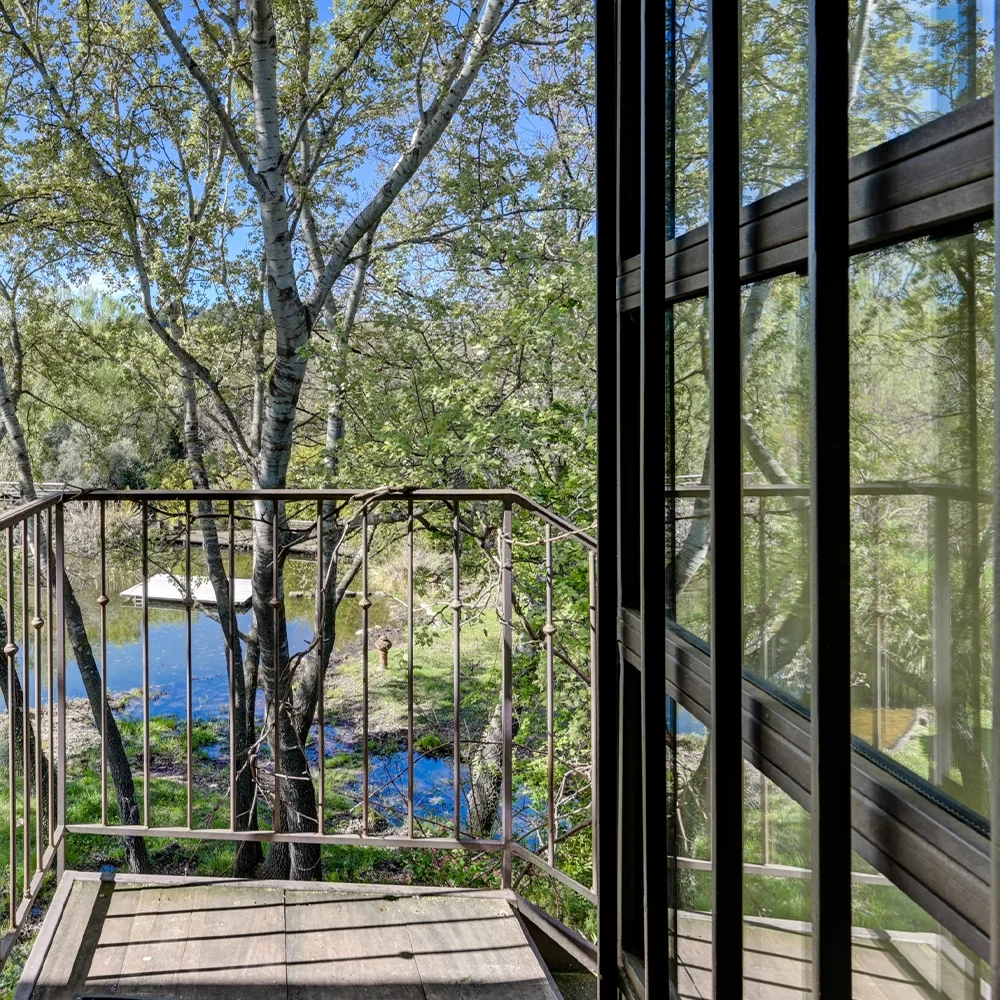
On your return, the grounds are bordered by the Aigue Brun, the very river that carved the gorge, with its natural pool under century-old trees. It is the best possible use of a late July afternoon, and the restaurant terrace is a few steps away.
For the rest of your stay, see our guide to things to do in Lourmarin and our tour of the most beautiful villages of the Luberon: several link together very well by bike, which remains the simplest way to avoid the July car parks.